Of all the parts of a nikah, the mahr is the one couples most often leave until the last minute, and the one families most often misunderstand. It is mentioned briefly in the ceremony, written into the contract and then, in many cases, rarely discussed again. Yet it is a meaningful commitment with real practical consequences. Understanding what mahr is, what it is not and how to agree it thoughtfully is one of the most valuable things a couple can do before the nikah.
This is general information to help couples understand the topic. It is not a religious ruling or legal advice. Views on details can differ between schools of thought and communities, so speak to a qualified scholar or imam for religious questions, and a solicitor for legal ones.
What Is Mahr?
Mahr is an obligation placed on the groom, to give the bride a gift or payment as part of the marriage contract. It is widely understood as a right of the bride, which belongs to her alone. It is not a payment to her family and it is not a price for the marriage. Many describe it as a sign of the groom's commitment, respect and responsibility towards his wife.
In practice, the mahr is agreed between the couple and stated at the time of the nikah. It is often recorded in the nikah contract, and the bride is entitled to receive it, either at the time of marriage, later or in part at each stage, depending on what has been agreed.
Mahr Is Not Dowry
One of the most common sources of confusion, especially in South Asian communities, is the difference between mahr and dowry. They are very different things.
- Mahr is given by the groom to the bride, and belongs to her.
- Dowry, often called dahej or jahez in South Asian cultures, is typically given by the bride's family to the groom or his family. It is a cultural practice, not part of the Islamic marriage contract, and many scholars and communities discourage it, particularly when it creates pressure or financial hardship.
Keeping the two separate in your own mind, and in conversations with family, helps avoid misunderstandings. The mahr should be agreed without pressure and without tying it to any demands from either side.
What Can Mahr Be?
Mahr can take several forms, and what is appropriate is a matter for the couple to agree, within the guidance of their scholar or community. Commonly, it is one of the following:
- A sum of money. This is the most common form in the UK, usually stated as an amount in pounds.
- Gold or jewellery. Particularly common in South Asian communities, and often given in a form the bride can keep or wear.
- Property or assets. Some couples agree on property, a vehicle or another valuable item.
- A benefit or service. Some scholars permit non-monetary forms where the value is clear and agreed. This is a topic to discuss with a scholar.
The key principle is that it should be something of value, clearly stated and agreed by both sides, and given willingly.
Prompt and Deferred Mahr
Mahr is often divided into two parts, and understanding the difference helps couples agree on terms that suit them.
- Prompt mahr. Paid at the time of the nikah or soon after. Many couples choose a modest prompt amount that is handed over during or shortly after the ceremony.
- Deferred mahr. Agreed at the nikah but payable later, for example on a stated date or on certain events, such as the end of the marriage. The terms should be clear, so that both sides understand when and how it is due.
Some couples agree the whole amount as prompt, others as deferred, and others as a combination. There is no single right choice. What matters is that the arrangement is clear, honest and written down.
How Much Should Mahr Be?
This is one of the most frequently asked questions, and the honest answer is that it depends on the couple. Islamic teaching places emphasis on ease and moderation, and encourages couples not to make marriage difficult through excessive demands. At the same time, mahr should reflect a genuine commitment and be meaningful to the bride. Different schools of thought also hold different views on whether there is a minimum amount, so a scholar can advise on the position that applies to your community.
Practical factors couples commonly consider include:
- The groom's financial position and ability to pay
- The bride's own wishes, which should carry real weight
- Family or community norms, balanced against what suits the couple
- Whether the amount is something that can be given without hardship or debt
- What the bride would find meaningful and secure
Avoid treating mahr as a status symbol or a bargaining point between families. It is a personal commitment between two people, not a display for guests.
How to Have the Conversation
Money and marriage are sensitive topics, and talking about mahr can feel awkward. A calm, early conversation between the two of you is much better than a rushed discussion on the day of the nikah. A few suggestions help.
- Talk to each other first. Discuss what mahr means to each of you and what you each hope for, before involving families.
- Learn together. Read reliable sources and, if you wish, speak to a scholar or imam who can explain the principles and answer questions.
- Be honest about finances. A realistic figure that can be honoured is better than an impressive one that cannot.
- Include the bride's voice. Mahr is the bride's right, so her wishes should be central to the decision.
- Involve families respectfully. If families are involved, make clear that the decision rests with the couple.
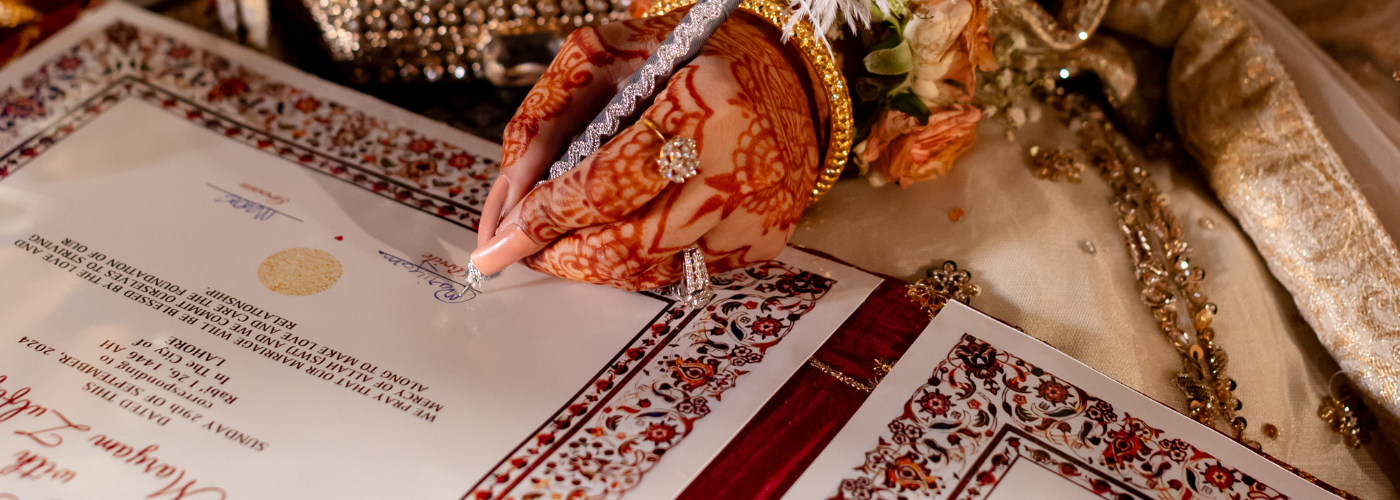
- Agree and write it down. Record the amount, the form and the timing before the nikah.
Writing Mahr Into the Nikah Contract
A clear written record protects both sides and avoids confusion later. When the mahr is recorded, it should be specific. A good record includes:
- The full names of the bride and groom
- The form and amount of the mahr, stated clearly, such as a sum in pounds or a described item
- Whether it is prompt, deferred or divided, with the amounts for each part
- When and how any deferred portion becomes due
- The date of the nikah and the names of the witnesses
- Signatures of the relevant parties, as required by the officiant or the community
Many mosques and imams provide a standard nikah contract form that includes a section for the mahr. Ask in advance, so that you can review the wording and fill it in with care. Keep a copy somewhere safe, along with proof of any payment or handover.
Mahr and UK Law
This is an area where it is worth being careful. In England and Wales, a nikah on its own does not automatically create a legally recognised marriage. Whether it does depends on factors such as whether the venue is registered for marriages and whether the ceremony meets the legal requirements. Many couples therefore also complete a civil marriage, so that their marriage is recognised in law and carries the legal protections that come with it. Our guide to Nikah planning 101 explains the options.
How a mahr agreement is treated by UK courts can be complicated, and may depend on the circumstances and on how the agreement was recorded. In some cases courts have treated mahr terms as a contractual obligation, but outcomes can vary, particularly where the marriage is not legally registered. For this reason it is sensible to:
- Record the mahr clearly and in writing
- Keep a signed copy of the contract
- Consider a civil marriage alongside the nikah, so that the marriage is legally recognised
- Take advice from a solicitor with experience in this area, if you want certainty about how it would be treated
Laws change and vary between the UK nations, so check current guidance for your situation.
Paying and Receiving Mahr
Once agreed, mahr should be handled with the same care as any significant commitment.
- Pay what was agreed, when it was agreed. If any portion is prompt, hand it over as arranged and keep a record.
- Keep evidence. A bank transfer, receipt or signed acknowledgement helps avoid doubt later.
- The bride controls it. The mahr is hers to keep, spend or save as she chooses.
- Be clear about deferred terms. Both sides should understand when a deferred amount becomes payable and how.
- Revisit if circumstances change. Some couples review the arrangement during the marriage. Any change should be mutual and recorded.
Common Misunderstandings
- "Mahr is the cost of the wedding." It is separate from wedding expenses such as venues, food and outfits.
- "It goes to the bride's parents." It belongs to the bride herself.
- "The bigger the better." Moderation and ease are encouraged, and an amount that cannot be honoured helps no one.
- "It is only symbolic." It is a genuine obligation, and should be treated seriously.
- "It does not need to be written down." A clear record protects both parties.
- "It is the same as dowry." It is not, and the difference matters.
Keeping the Focus on What Matters
It is easy for wedding planning to become dominated by logistics, such as venues, outfits and menus, while the meaning of the nikah itself is pushed to the side. Taking time to understand and agree the mahr is a good way to keep the focus on the commitment that the day is about. If you are balancing the practical and the spiritual sides of your wedding, our guide to balancing simplicity and celebration in a Muslim wedding may be helpful, and our guide to the walima covers the celebration that follows.
Frequently Asked Questions
Can the mahr be agreed after the nikah?
It is generally understood that the mahr should be specified at or around the time of the nikah. If it was not stated, scholars have views on how it is determined afterwards, so seek advice from a qualified scholar instead of assuming.
Can the bride waive or reduce her mahr?
Many scholars hold that the bride may choose to forgo some or all of it, provided the decision is made freely and without pressure. Because this is a sensitive area, it is worth ensuring that any such decision is genuinely her own and discussed with a scholar if there is any doubt.
Can mahr be paid in instalments?
Couples often agree to split it into prompt and deferred portions, and some agree a schedule. What matters is that the terms are clear, agreed and recorded.
Do we need to tell guests the amount?
No. The amount is a private matter between the couple and the witnesses. Some nikahs announce it and others do not, and there is no need to make it public if you prefer not to.
A Simple Mahr Checklist
- Learn what mahr is and how it differs from dowry.
- Talk to each other about what it means to you.
- Speak to a scholar or imam if you have questions.
- Agree the form, amount and timing, with the bride's wishes central.
- Decide whether it is prompt, deferred or divided.
- Write it clearly into the nikah contract.
- Keep a signed copy and proof of payment.
- Consider civil registration and legal advice for clarity under UK law.
Final Thoughts
Mahr is a small line in a contract with a large meaning. Treated thoughtfully, it is a reflection of respect, responsibility and honesty between two people about to begin a marriage. Have the conversation early, keep it free of pressure, agree something real that can be honoured, write it down and keep the records safe.
When you are ready to plan the events around your nikah, you can browse venues, caterers, decor and more across 17 categories on Wedsi, free for couples.